.webp)
Every year, millions of people around the world suffer or die due to work-related causes. In 2025, this problem continues to affect both developed and developing countries.
According to the latest data from global safety bodies like the ILO, the U.S. Bureau of Labor Statistics, and the UK’s HSE, workplace deaths remain a major concern. While some regions are seeing improvements, the overall impact is still massive.
🔎 Looking for last year’s report?
Read our 2024 workplace fatality article here.
The Health and Safety Executive (HSE)(4) released the latest fatal injury statistics for Great Britain:
Mesothelioma, a deadly cancer caused by asbestos exposure, killed 2,218 people in the UK in 2023. This number continues to fall as older cases decline over time.
According to the U.S. Bureau of Labor Statistics (3):
Recent Eurostat (4) estimates show:
High-risk sectors across the EU include construction, transport, and manufacturing. Smaller businesses (SMEs) also face more challenges due to limited safety budgets.
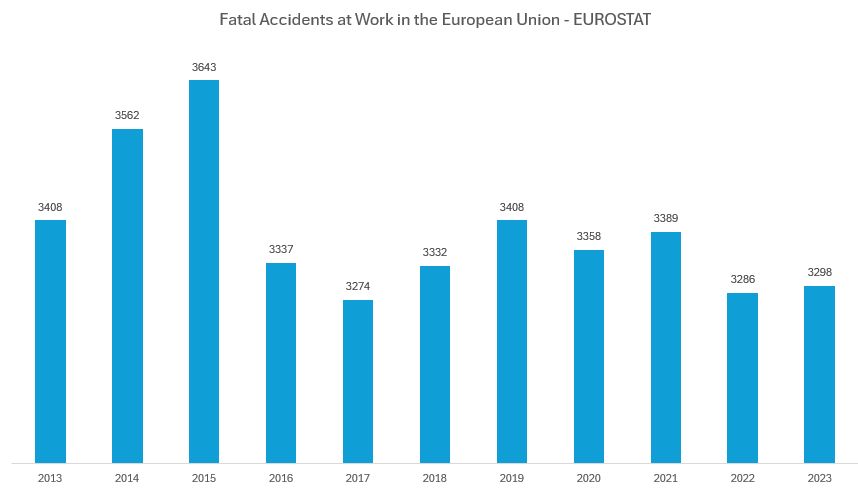
Workplace accidents don’t happen at random. They are more common in certain industries, regions, and company types.
Construction, manufacturing, agriculture, and waste management continue to report the highest number of both fatal and non-fatal workplace injuries. These jobs involve physical tasks that carry greater daily risks, including working at height, with heavy machinery, or in unpredictable environments.
Small and medium-sized enterprises (SMEs) often lack resources for safety training, proper equipment, or full-time safety staff. This puts their workers at greater risk. SMEs make up a large part of the EU’s workforce, so targeted support for these businesses is vital.
Not all regions face the same level of risk. Eastern European countries still report higher fatality rates, while Western Europe has generally lower figures thanks to stronger enforcement, more resources, and widespread safety culture.
Recent findings also point to an important shift. Safety isn’t just about equipment or procedures. Human factors like stress, fatigue, rushing, and complacency contribute to most injuries—even when hazards are known.
The EU continues to work on improving occupational safety through better legislation, training initiatives, and funding programs. But statistics show we still have work to do.
Most work-related deaths happen outside Europe and North America. According to the ILO (1), the Asia-Pacific region alone accounts for nearly 63% of all global workplace deaths. This is partly due to its large workforce, rapid industrial growth, and gaps in safety enforcement.
In India, fast-paced urban development and informal labor markets make safety harder to manage. Many workers in construction, mining, and small manufacturing face daily risks with little training or protective equipment.
In Latin America, countries like Brazil and Mexico are making progress with national safety strategies, but informal work and underreporting remain serious issues. Regional campaigns and labor reforms have helped, but fatality rates are still high in industries like agriculture, transport, and oil extraction.
These regions highlight the global safety gap. While some areas are improving, millions of workers are still exposed to preventable risks every day.
Behind every number is a real person. Someone who had plans, people who loved them, and a life that mattered. When we talk about 3 million deaths or millions of injuries, it’s easy to lose sight of that. But each case represents heartbreak. A life lost. A family changed forever. A community left with questions and grief.
Workplace safety is not just about following rules. It’s about care. It’s about making sure people go home at the end of the day. It's about honoring lives by preventing the next tragedy before it happens.
Every injury that doesn’t happen is a story that keeps going. A future that stays intact. A loved one who makes it home.
Learn, practice, and build safer habits in minutes with YOUFactors.
 See How it Works ▶️
.avif)