The accident frequency rate is one of the most widely used workplace safety metrics. It shows how often accidents happen compared with the total number of hours worked.
Health and safety teams use the accident frequency rate AFR to monitor safety performance and spot trends. Regulators, clients, and senior management also rely on it when reviewing safety records.
In simple terms, the all accident frequency rate gives organisations a standard way to compare safety results across different teams, sites, or time periods.
But while the accident frequency rate is useful, it mainly tells you what happened in the past. It does not explain why accidents occurred or how to prevent the next one.
The accident frequency rate definition describes how many workplace accidents occur during a specific number of working hours. It adjusts accident numbers so companies of different sizes can be compared fairly.
Put simply, accident frequency rate explained means measuring how often accidents happen relative to exposure. Exposure refers to the total hours worked by employees.
For example, a company with 1,000 workers will naturally record more incidents than one with 50 workers. The accident frequency rate corrects for this difference by comparing accidents against working hours.
Because of this, organisations use accident frequency rates to track performance over time and benchmark safety performance across industries.
The accident frequency rate calculation uses a standard formula so safety results can be compared between companies.
Without standardisation, larger organisations would appear to have worse safety records simply because they employ more people.
Most companies calculate AFR using either 200,000 hours or 100,000 hours as a base figure. These numbers represent typical working hours across a workforce.
When people ask how do you calculate accident frequency rate, they are referring to this standardised method. The accident frequency rate formula converts raw accident numbers into a comparable safety indicator.
The most common accident frequency rate formula is based on 200,000 hours. This represents the average number of hours worked by 100 employees in a year.
Accident Frequency Rate Formula
(Number of Accidents × 200,000) ÷ Total Hours Worked
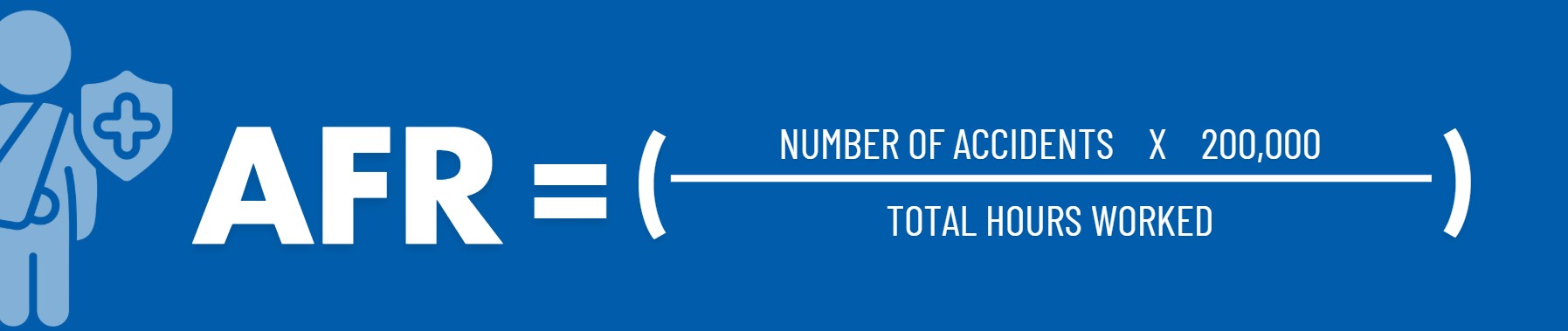
Here is what each part means:
This accident frequency rate calculation allows organisations to compare safety performance fairly, regardless of workforce size.
Some industries prefer different bases when calculating the AFR accident frequency rate.
For example, construction and manufacturing companies sometimes use 100,000 hours as the reference point. Large industrial sectors may use 1,000,000 hours.
These variations do not change the meaning of the accident frequency rate formula. They simply adjust the scale used for reporting.
However, when comparing companies, it is essential that the same base is used. Otherwise, the accident frequency rate calculation will not produce reliable comparisons.
Not every workplace incident is included in the accident frequency rate.
Most organisations count only reportable injuries. In the UK, these are typically incidents covered by RIDDOR regulations.
Examples of incidents that may be included in accident frequency rates are:
Clear definitions are important. If reporting rules are unclear, the accident frequency rate AFR may not reflect the real level of workplace risk.
A lost time injury refers to an injury that prevents a worker from doing their normal job for at least one full working day after the incident.
Understanding the LTI safety meaning is important because lost time injuries often have the biggest impact on the accident frequency rate.
Workplace injuries are usually grouped into categories such as:
Because LTIs indicate more serious incidents, they often receive the most attention when analysing the accident frequency rate calculation.
There is no universal “good” accident frequency rate. The acceptable level depends heavily on the industry and the level of risk involved.
For example, high-risk sectors such as construction or manufacturing will usually have higher accident frequency rates than office-based businesses.
Instead of focusing on a single number, safety professionals often look at trends. A steady reduction in the accident frequency rate AFR suggests safety practices are improving.
A sudden increase in the accident frequency rate may indicate emerging safety issues that need attention.
The accident frequency rate measures how often accidents happen relative to working hours.
An incident rate, on the other hand, can include a wider range of safety events.
These may include:
The accident frequency rate AFR focuses mainly on injuries. Incident rates capture a broader picture of safety performance.
Both metrics have value. But relying only on accident frequency rates may mean missing early warning signs.
The accident frequency rate is considered a lagging indicator. It measures incidents that have already happened.
Near misses provide a different perspective. They highlight risks before injuries occur.
By analysing near misses, companies can identify hazards that could eventually increase the accident frequency rate AFR.
Many modern safety programmes track both metrics. This helps organisations act before incidents raise the accident frequency rate.
Reducing the accident frequency rate requires more than reacting to incidents after they occur.
Organisations that improve safety usually focus on proactive strategies such as:
Many incidents are linked to human factors such as distraction, fatigue, or rushing. Behaviour-based safety programmes aim to address these risks before accidents occur.
These approaches can help lower the accident frequency rate over time.
Discover how the YOUFactors health and safety platform helps teams identify risks earlier through near-miss reporting, behaviour-based safety observations, and real-time safety insights. Move beyond lagging metrics like accident frequency rate and start preventing incidents before they happen.
.webp)
Learn, practice, and build safer habits in minutes with YOUFactors.
 See How it Works ▶️
.avif)