.webp)
If you work in health and safety, you have probably heard a version of this claim before:
Hundreds of near misses happen before one serious accident.
That idea has been repeated for decades. It still appears in safety talks, training sessions, and articles. It sounds simple, memorable, and useful.
But is it actually true?
The honest answer is yes, historically there are famous ratios behind it, but no, there is not one fixed number you can rely on today. Modern safety experts now say the real issue is not how many near misses happen. It is which near misses had the potential to cause a life-changing injury or fatality.
A near miss is also rarely just about the hazard itself. In many cases, human factors such as rushing, fatigue, frustration, or complacency, shape whether a close call stays minor or turns into a serious accident. That is why the quality of the event matters more than the raw count.
The idea comes from two very well-known safety models.
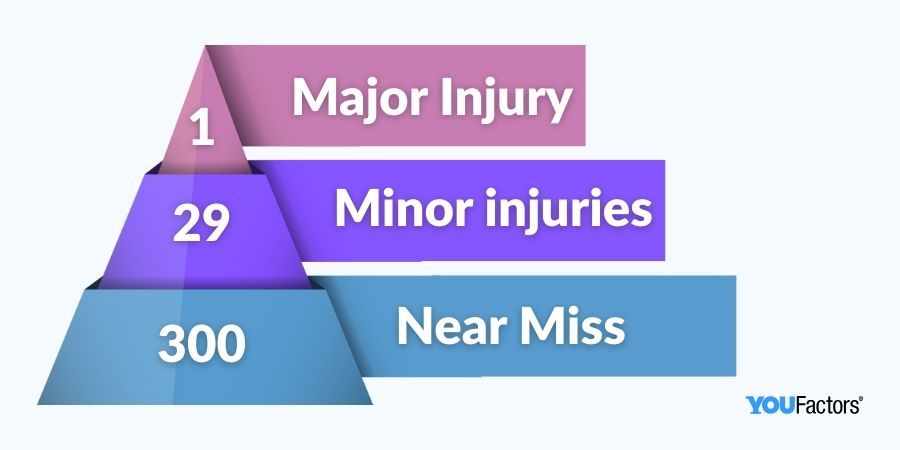
The first is Heinrich’s triangle. Heinrich observed that for every 1 major injury, there were 29 minor injuries and 300 no-injury incidents. That is why many people still say a serious accident is preceded by around 300 near misses or no-injury events.
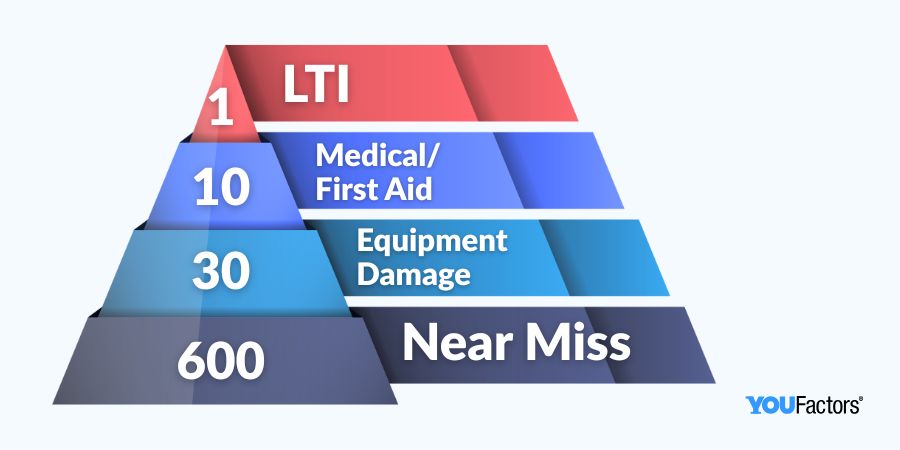
A later model from Frank Bird pushed that thinking further. Bird’s work is often shown as 1 lost-time injury, 10 medical or first-aid cases, 30 equipment-damage incidents, and 600 near misses. Safe Work Australia says Bird’s 1969 study is said to have reviewed 1,753,498 incident reports from 297 firms in 21 industrial groups.
So if someone asks, “How many near misses occur before a serious accident?” the classic historical answer is usually:
That is the answer many readers expect. But stopping there would leave out the most important part of the story
These old models were useful because they helped people see that small incidents matter. They pushed safety leaders to pay attention to weak signals instead of only reacting after someone got badly hurt.
But modern safety research says the ratio should not be used as a fixed prediction rule for serious injuries and fatalities. Safe Work Australia says the ratio appears to depend on organizational context and notes that few people would expect the old ratios to hold true today without criticism or adjustment. IOSH also states that incident causation and prevention are more complex than Heinrich’s Accident Triangle Theory.
The Campbell Institute explains the key flaw clearly. Not all non-injury incidents are equal. Some near misses contain the precursors that could lead to a serious injury or fatality. Many do not. In other words, counting every near miss the same way can hide the events that matter most.
That changes the whole conversation.
It means the better question is not:
How many near misses happened?
It is:
How many near misses had serious injury or fatality potential?
Imagine two near misses:
Both may be logged as near misses. But they do not carry the same potential for catastrophic harm.
The Campbell Institute says only some near misses have the precursors that could lead to recordable injuries, lost-time injuries, or fatalities. It also says incidents with serious injury and fatality potential are fundamentally different and often have different root causes and contextual factors.
The level of risk in a near miss does not depend only on the task or physical hazard. It also depends on the human state involved. A distracted office worker and a fatigued operator working around moving equipment are both experiencing a near miss, but the second situation may carry far greater serious injury potential. Human factors change the odds of making a critical error at exactly the wrong moment.

This is especially true when human factors combine with high-energy hazards such as vehicles, suspended loads, electricity, work at height, line-of-fire exposure, or machine intervention. In those moments, rushing, frustration, fatigue, and complacency can turn an ordinary close call into a life-altering event.
This is one of the biggest misunderstandings in safety.
Many organizations have worked hard to reduce recordables, first-aid cases, and minor injuries. That is good progress. But a drop in total injury rates does not always produce the same drop in serious injuries and fatalities.
A Campbell Institute-supported study found two main reasons for this.
First, the causes and correlates of serious injuries and fatalities are often different from those of less serious injuries.
Second, the potential for serious injury is low for the majority of non-SIF injuries, at about 80%. The same study says the predictive side of Heinrich’s triangle is not supported in the way many organizations assume.
That helps explain why some companies can celebrate lower recordable rates while still being exposed to fatal risks. The warning signs were there, but they were buried inside broad injury counts and generic near-miss totals.
Human factors help explain this gap. A company may reduce minor incidents through better housekeeping, PPE use, or general compliance, while still leaving workers exposed to serious-risk situations shaped by fatigue, overload, time pressure, distraction, or routine complacency. That is one reason a lower total incident rate does not automatically mean lower serious injury risk.
The most accurate answer is this:
Historically, classic models suggested around 300 to 600 near misses before one serious accident. But modern safety experts say there is no single universal number that reliably predicts when a serious injury will happen.
That is because serious injuries do not arise from all near misses equally. They are more strongly linked to a smaller set of high-risk events, exposures, and failed controls.
So if your organization is still using a simple near-miss count as proof that risk is under control, it may be missing the bigger picture.
A smarter approach is to look beyond the total number of near misses and ask better questions:
This gives safety teams something far more useful than an old ratio. It gives them a way to spot the near misses that could become tragedies.
Companies should also ask human-factor questions:
The old safety triangles still matter. They helped shift attention toward prevention. They reminded us that serious accidents rarely come out of nowhere.
But today, the best safety thinking goes a step further.
It says the number of near misses on its own is not enough.
What matters most is the quality of the signal, not just the size of the count.
And that signal becomes much clearer when you look at both sides of the event: the hazard exposure and the human factors present at the time. A near miss involving high energy and a worker who is rushing, fatigued, distracted, or frustrated deserves a very different response from a low-consequence event with little serious injury potential.
Near misses are not only about hazards. They are often shaped by human factors like rushing, frustration, fatigue, complacency, and distraction.
YOUFactors helps organizations address those everyday states through digital learning, microlearning nudges, and habit-building tools designed to reduce human error before it leads to injury, downtime, or loss.
Get a demo of YOUFactors to see how your team can build safer habits, spot risk earlier, and take a more proactive approach to serious injury prevention.
Learn, practice, and build safer habits in minutes with YOUFactors.
 See How it Works ▶️
.avif)